Clay and Patience
A day at the Foro Italico

My last post here was on Elena Rybakina’s remarkable triumph at the Australian Open. Yesterday, I had the chance to see her play from up close in the stands at the Italian Open in Rome. A different surface brought with it a different challenge. But Rybakina won all the same, defeating Alexandra Eala, the Philippines’ 20-year-old rising star, 6-4, 6-3 in the Round of 32.
Eala toiled hard, made Rybakina do what she dislikes most — defend — but ultimately could not find a way through. In many ways, this felt like something of a litmus test for Rybakina, who is eyeing success in the clay at Roland Garros, a surface on which she has historically struggled to impose herself, despite two major titles to her name.
Rybakina’s game is naturally suited to quicker surfaces, where the weight and flatness of her groundstrokes can instantly put opponents under pressure. On clay, though, especially against certain opponents, she is often required to play the extra ball. The one enduring antidote is her serve, which she deployed to devastating effect only intermittently yesterday. But when it clicks, it remains one of the most formidable weapons in the sport.
In writing about Roger Federer in 2006, the late novelist David Foster Wallace described just how different watching tennis on television is from watching it live — especially from a seat close to the action. On TV, you can grasp the broad contours of a point, but in person, you can grasp the geometry of the court unfold in real time, the angles players use, the tactical patterns they deploy to move opponents inch by inch out of position, the extraordinary spin and sheer velocity behind every groundstroke.
With Rybakina, what was most striking was the imperious quality of her serve. Her ball toss reveals almost nothing about where the serve is going. Equally striking was how abruptly she could redirect rallies, particularly with the forehand down the line, which yielded a succession of clean winners. Eala had a considered plan on return: to loop the ball back heavily, and give Rybakina as little pace as possible to work with. Rybakina’s response was to flatten her shots out, hitting with minimal topspin — not the ideal formula on clay, but effective enough on the day.
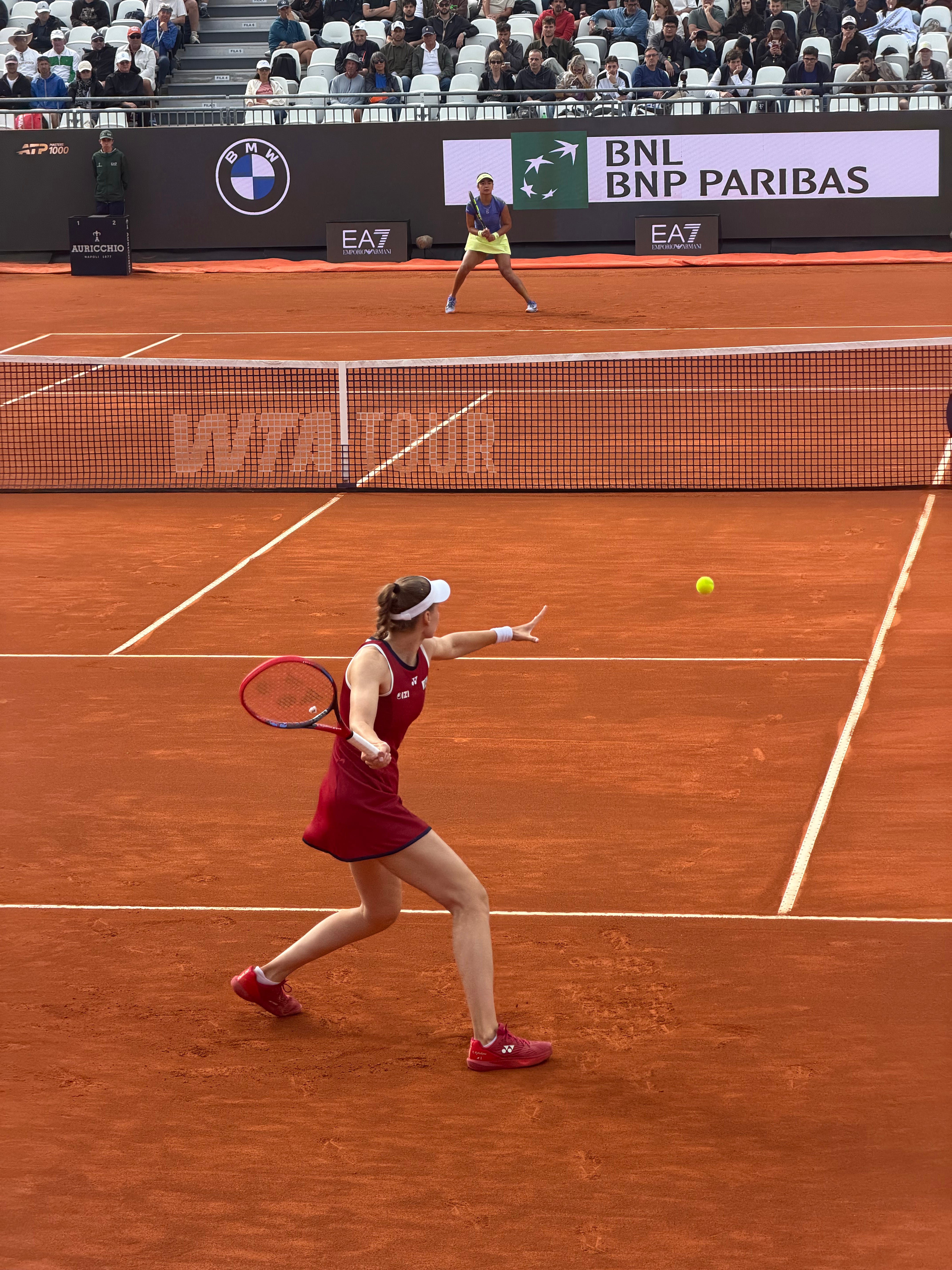
Four other matches were on show at the newly installed BNP Paribas Arena — the Foro Italico’s second court. The pick of them was Luciano Darderi’s comeback victory against Tommy Paul. For a set and a half, Paul was superb: aggressive, precise, and entirely in control. Unlike the Rybakina match, this one was built on long, probing rallies, with both players willing to grind patiently until the right opening arrived to pounce. There was heavy baseline hitting, deft backhand slices, and the occasional foray forward to finish points at the net.
Then, Paul’s level dipped dramatically midway through the second set, while up a break. Darderi seized on it without hesitation, refusing to afford his opponent an inch. He pushed Paul deeper behind the baseline and used the drop shot with real intelligence and disguise. With the crowd behind him, Darderi just wouldn’t allow Paul a way back.
By the end of the evening, though, the results fade from the mind. What lingers is the athletic excellence on display, and what makes clay court tennis so compelling: the problem-solving in real time, the physical attrition, the constant negotiation between patience and aggression.