Five days at the Foro
On tennis at the Italian Open

Consider the photograph below. This is Stadio Nicola Pietrangeli, the fourth show court at Rome’s Foro Italico. It’s packed to its rafters, only a few hundred short of four thousand people, arranged on tiers of Carrara marble that descend from the ground into a rectangle of ochre clay. Eighteen male nudes survey the scene from above, statues also cleaved from the same marble, their bodies meant to demonstrate attitudes of athletic perfection: throwing, lunging, straining. Below them, the big-hitting Serb, Hamad Medjedovic and Argentina’s clay-court specialist, Mariano Navone are playing a round of 32 match at the Italian Open Masters 1000. The atmosphere, even though neither is from Italy, is electric—every member of the crowd is engrossed in the action. And the sight it produces is one to behold.
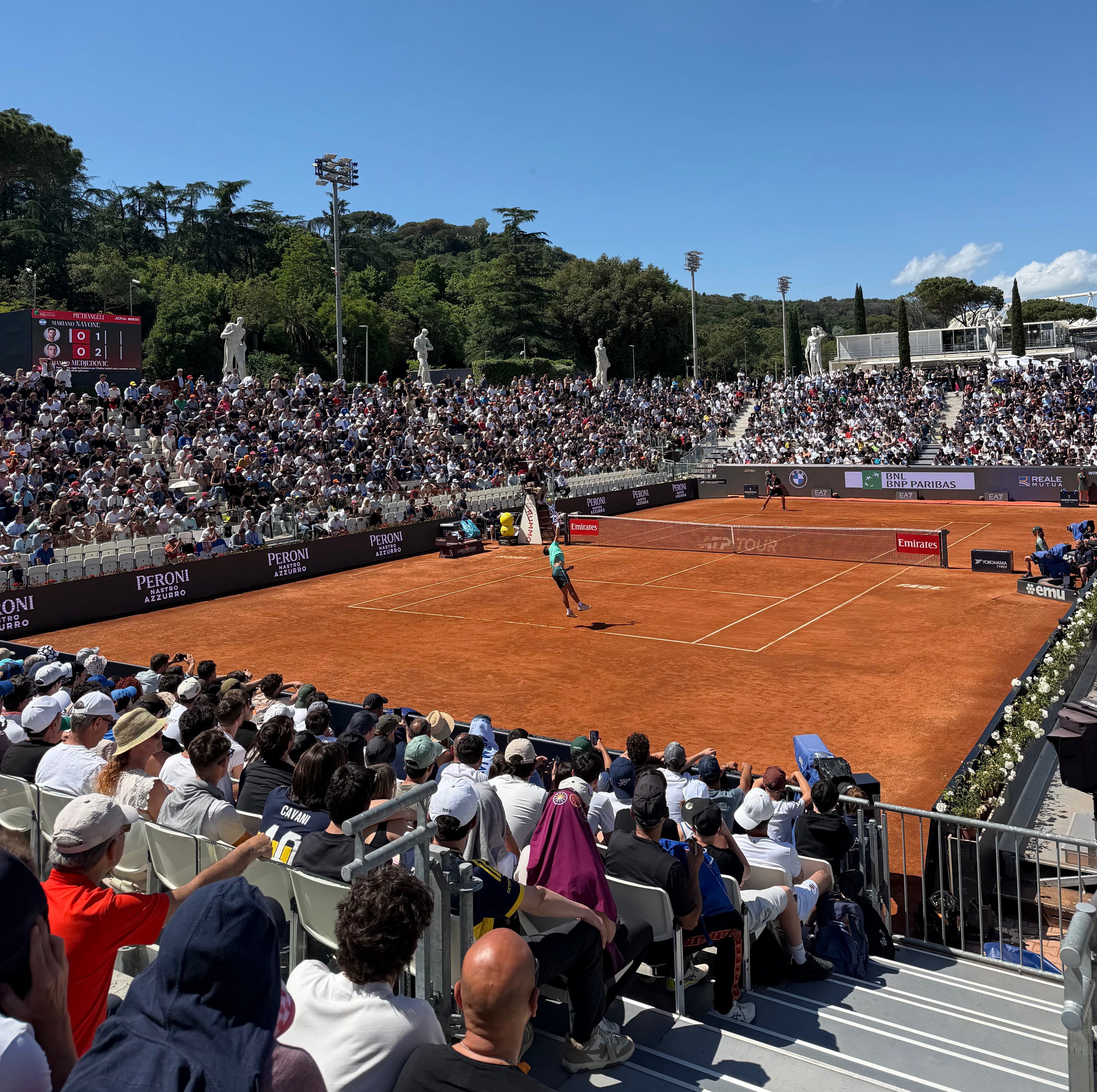
The internet has decided, with something of an unusual consensus, that Stadio Pietrangeli is the most beautiful tennis arena on earth. Erase all its history, and it would be difficult to argue against this. The intimacy of the space and the way it seemingly brings together antiquity and modernity mean that it has a special capacity to induce awe. But to experience this feeling honestly and fully, one must hold it against what the place was built to mean.
***
The complex on which Pietrangeli rests was not always called the Foro Italico. It was inaugurated in 1932 as the Foro Mussolini, conceived to celebrate the 10th anniversary of the March on Rome. It had as its architects, Enzo Del Debbio, Luigi Moretti, and Constantino Costantini, together commissioned by the Opera Nazionale Balilla, an Italian Fascist youth organization. Mussolini had declared himself as dictator in 1925, and almost immediately set about reshaping the country’s landscape through a series of public works projects. This included a football stadium, athletic tracks, an Olympic swimming pool and even these tennis courts, where the world’s best players compete each May. The project wasn’t merely civic. It was political and built on an ideology of division.
The statues that overlook the Pietrangeli and populate the broader complex were expressions of the culto del corpo, fascism’s cult of the body. Physical perfection was ideological perfection. Discipline, strength, and endurance were not merely sporting virtues but virtues of the state itself. When Italian athletes won on the world stage, Mussolini weaponised their triumphs as proof of racial superiority, as an advertisement for what his fascist governance could produce in human form.
Even the word tennis offended him. He refused to use it, preferring instead pallacorda, which refers to the age-old Roman game of String Ball. The court that now bears Pietrangeli’s name — the two-time French Open champion and, arguably, Italy’s greatest player of the twentieth century — was originally named the Pallacorda.
Unlike Germany, which passed legislation in 1949, suppressing the public symbols of the Third Reich, Italy underwent no equivalent reckoning. The Foro Mussolini was simply rechristened. The statues remained. The marble obelisk at the entrance, containing the words “Mussolini Dux”, still stands. The symbols were not dismantled. They were recontextualised, and absorbed into a vague notion of Roman heritage, glamorised until their origins almost became deniable.
***
The modern Foro Italico has grown considerably around its uncomfortable foundations. The Campo Centrale, the Centre Court, seats more than ten thousand spectators; a Grandstand has been renamed the BNP Paribas Arena after its principal sponsor; and a new Super Tennis Arena has been built alongside the older courts. The tournament, already one of the most admired on the Masters 1000 calendar, has acquired genuine grandeur. It is a place where the sport’s elite converge and where, in the right conditions, something approaching magic becomes possible.
Over five days in Rome, I had the chance to see some of that magic unfold. Sport asks of us to suspend disbelief, but not necessarily to suspend the past. Yet, when you watch Jannik Sinner from the bleachers high up on Campo Centrale, with the Roman sun beating down heavily, till your ears turn red, the forgetting comes easily. The precision and the almost algorithmic consistency of his groundstrokes draw the crowd into a shared intake of breath. You gasp together, and your jaw drops with the person beside you.
But it was tennis at the Grandstand which offered the most riveting pleasure. Seated close enough behind the baseline to feel the air move as a ball is struck, you see first-hand, the pace, the spin, and the crack that the racquet makes when it contacts the tennis ball. It was from such a seat that I watched Iga Swiatek dismantle Naomi Osaka, en route to her first semifinal of the year, a performance suggesting that whatever had gone awry for her previously had started correcting itself. And here it was that I saw Andrey Rublev and Nikoloz Basilashvili conduct a sustained, physically gruelling duel from the baseline. Nobody in men’s tennis averages a bigger backhand than Basilashvili and you could feel the seats reverberate every time he thumped one. The great Marat Safin was seated only a few seats to the right, there as coach, overseeing Rublev’s revival. Also on view was Daniil Medvedev, navigating his way past Spain’s Pablo Llamas Ruis. The Russian’s rare tennis intelligence was evident, his use of angles a thing of beauty. But even more arresting was the purity of his ball striking. With Medvedev, every contact appears to come from his racquet’s sweet spot, making a sound unlike anything produced by the game’s other practitioners.
***
The best part of the week, though, was seeing the nineteen-year-old Spaniard Rafael Jodar. Ranked outside the world’s top 900 until last year, he had been a student at the University of Virginia and his tennis future was, at best, speculative. He left college in December. And he left Rome ranked in the top 30. His rise has been so steep that no one has really caught up with it, and nor, in some endearing way, has he himself.
Jodar is lanky, lean, almost ungainly until the ball is in play, at which point something else takes over. The speed he generates from either wing, and the flat and almost contemptuous violence of his groundstrokes, belie his frame. In his match against the American prodigy Learner Tien, there were moments of such startling quality that it is hard not to imagine him finishing in the top 10 by year-end.
There is also, with Jodar, a striking absence of surrounding apparatus. No entourage, no coach muttering instructions from the players’ box, no sports psychologist or fitness trainer. In his corner, there’s only his father, Rafael Sr., a former women’s basketball coach. Jodar sometimes walks to the service line and readies himself to serve even before the ball kids have taken their positions. He will no doubt have his ups and downs. Conditions will change, opponents will work out how to play him, but he has that rarest of gifts: easy power.
***
When you walk through the Foro Italico today, the ease with which history dissolves into spectacle offers a lesson of its own. The crowds are here for Sinner and Swiatek, here for the tennis. The monuments ask no questions, and the tournament asks fewer still.
But sport and politics have never been fully separable. Marta Kostyuk, who won in Madrid only days before, has spoken of carrying the weight of Ukraine’s war, of sharing the “pain of people.” Rome had its own Ukrainian story. Elina Svitolina produced some of the best tennis of her life, defeating Elena Rybakina, Swiatek and Coco Gauff, on her way to her 20th title. And in Barcelona, even as the tennis was unfolding, football genius Lamine Yamal waved a Palestinian flag at the club’s La Liga victory parade, to the declared pride of Spain’s prime minister Pedro Sanchez.
The Foro Italico was built as a monument to a singular political idea of human perfection. That idea was both a disgrace and a disaster. Today, as its traces dissolve into the larger infrastructure of the tournament, we are left to remind ourselves that the ground beneath sport is never neutral, that it never has been.
Really enjoyed reading this, Suhrtih. The mix of historical context and sport reportage was very well done.
Good to see you back here - hope you keep writing! :)